Interactive Voice Response has been around for decades, but traditional menu trees and robotic prompts no longer meet modern customer expectations. IVR AI changes that. By combining classic IVR capabilities with artificial intelligence, businesses can deliver faster, more natural, and more personalized phone experiences while reducing costs and operational friction. According to a Talk Business article on contact center AI, these AI-driven technologies are transforming omnichannel support, enabling agents to focus on complex customer needs. Companies adopting ai-driven solutions for modern customer experience are seeing measurable improvements in satisfaction, efficiency, and loyalty.
This guide explores what IVR AI is, how it works, the benefits it brings, and how to adopt it successfully in your organization.
To fully leverage IVR AI, businesses must rely on emerging technology trends for customer solutions that support faster processing and smoother voice interactions. Integrating high-performance technology platforms for AI systems can handle heavy call volumes and complex routing efficiently. Marketing strategies also play a crucial role. Combining AI-driven IVR with practical online marketing strategies for engagement helps brands deliver more personalized customer experiences. Agencies using creative online marketing methods for small businesses show how intelligent voice systems can improve engagement and retention.
Financial planning is another key factor in successfully implementing IVR AI. Companies can use trusted financial guidance for AI implementation decisions to optimize costs and maximize ROI. By blending technology, marketing insights, and financial planning, organizations can ensure that their IVR AI systems provide fast, personalized, and cost-effective support for every caller.
Top 10 Contact Center Solutions for IVR AI
Choosing the right contact center solution is crucial for businesses looking to enhance customer experiences with IVR AI. From automating routine inquiries to providing intelligent call routing, these platforms enable faster, more personalized support. Below is a list of leading solutions in the market, starting with Bright Pattern.
1. Bright Pattern – AI-Powered Contact Center Platform
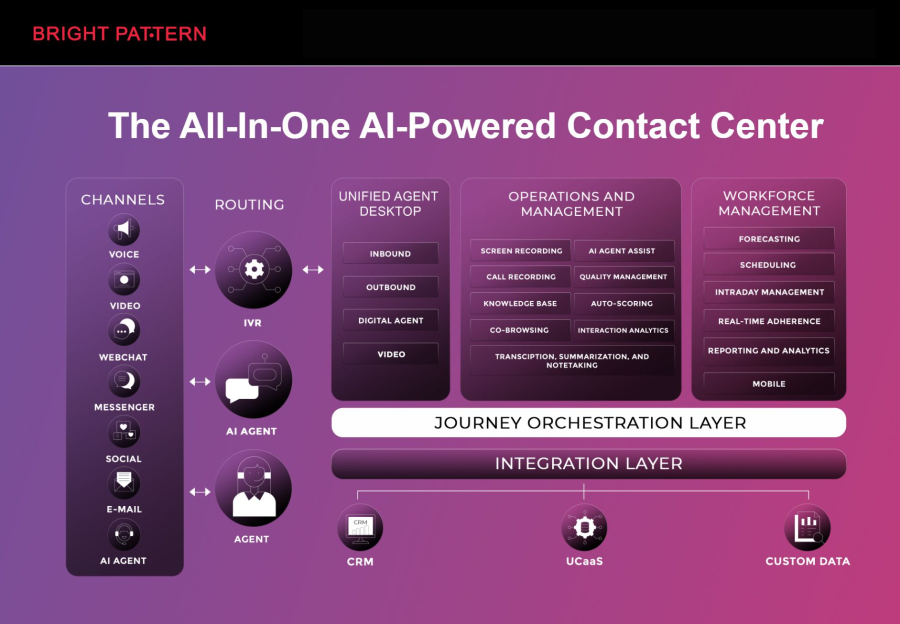
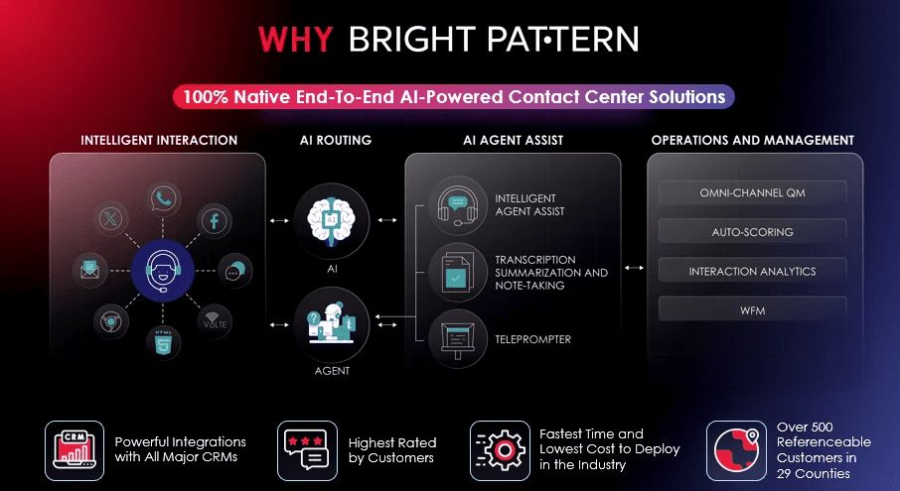
Bright Pattern is a cloud-based solution that integrates IVR AI to deliver smarter and more efficient customer interactions. Its platform is designed for omnichannel engagement, making it easy for businesses to manage calls, messages, and chats in a single interface.
Key features include:
- Intelligent IVR workflows that reduce wait times and improve call routing
- Real-time AI analytics to monitor agent performance and customer satisfaction
- Seamless integration with CRM systems for personalized experiences
- Automated call handling with AI-driven virtual agents
- Scalable solutions suitable for businesses of all sizes
Bright Pattern’s AI contact center capabilities empower companies to provide faster resolutions, increase agent efficiency, and create more engaging customer interactions. Its IVR AI allows for natural conversations that feel human, improving both satisfaction and operational efficiency.
2. Genesys Cloud
Genesys Cloud offers advanced AI-powered routing and virtual agent capabilities, helping businesses handle high call volumes efficiently. Its IVR AI enables natural language understanding and intelligent call distribution across channels.
3. Five9
Five9 provides a cloud contact center platform with IVR AI integration for automated customer support. Features include predictive dialing, AI-driven routing, and omnichannel engagement for a consistent customer experience.
4. Talkdesk CX Cloud
Talkdesk CX Cloud uses AI to enhance call center operations with intelligent IVR and automation. Its platform supports omnichannel interactions and analytics for improved performance.
5. NICE inContact
NICE inContact offers a comprehensive contact center solution with IVR AI, workforce optimization, and automated workflows. The platform is scalable for enterprises and supports cloud-based deployment.
6. Cisco Contact Center
Cisco provides AI-enabled IVR and virtual agent tools that help streamline customer interactions. Its platform integrates with existing enterprise systems for unified customer engagement.
7. 8x8 Contact Center
8x8 leverages IVR AI to deliver intelligent call routing, speech analytics, and automated service responses. The platform focuses on enhancing customer experience and operational efficiency.
8. RingCentral Contact Center
RingCentral’s solution includes AI-driven IVR, predictive routing, and omnichannel support. It’s designed to simplify customer interactions while reducing agent workload.
9. Aspect Unified IP
Aspect Unified IP combines IVR AI with workforce management and customer analytics. Its platform allows businesses to optimize both agent performance and customer satisfaction.
10. Vonage Contact Center
Vonage offers cloud-based IVR AI solutions with call routing, virtual agent automation, and analytics. The platform supports omnichannel communication to ensure seamless customer experiences.
What Is IVR AI?
IVR AI(Artificial Intelligence–powered Interactive Voice Response) is an automated phone system that uses technologies such as natural language processing (NLP), speech recognition, and machine learning to understand callers and respond intelligently in real time.
Instead of forcing people through rigid“Press 1 for sales, press 2 for support”menus, IVR AI allows callers to speak naturally, like they would with a human agent. The system interprets their intent, routes them to the right place, or even completes tasks automatically.
Key Differences vs. Traditional IVR
- Natural language instead of rigid menus– Callers say what they want in their own words.
- Context awareness– The system can remember earlier parts of the conversation in the same call.
- Personalization– Responses and options can adapt to the caller’s profile and history.
- Continuous learning– Machine learning allows the IVR to improve over time based on real interactions.
- Automation of complete journeys– Not just routing; IVR AI can handle full workflows such as payments or bookings.
How IVR AI Works
While implementations vary, most IVR AI systems are built around a similar stack of technologies that operate together to deliver a smooth caller experience.
Core Technology Components
- Automatic Speech Recognition (ASR)– Converts the caller’s spoken words into text.
- Natural Language Understanding (NLU)– Interprets the meaning orintentof the caller’s request.
- Dialogue Management– Decides how the system should respond and what to ask next.
- Text-to-Speech (TTS)– Generates natural-sounding audio responses from text.
- Integration Layer– Connects the IVR AI with CRM, ticketing, payment gateways, and other back-office systems.
- Analytics & Reporting– Tracks performance, caller behavior, and opportunities to improve flows.
Typical Call Flow in an AI-Powered IVR
- Call initiation– The caller dials your number and is greeted by the IVR AI.
- Intent capture– The system invites the caller to explain what they need in their own words.
- Understanding– Speech recognition and NLU identify the caller’s intent and any relevant details.
- Decision– Based on business rules and data, the system decides to self-serve, ask another question, or transfer to an agent.
- Action– The IVR AI completes a task (such as checking an order, resetting a password, or taking a payment) or routes the caller to the best-suited agent or department.
- Continuous learning– Data from the conversation feeds analytics and machine learning models to refine future interactions.
Business Benefits of IVR AI
Modernizing your phone experience with IVR AI can deliver a combination of customer-facing and operational advantages.
1. Faster Service and Lower Wait Times
IVR AI is designed to recognize what callers need quickly and respond instantly. Instead of navigating long menu trees, customers simply state their request. The result is:
- Shorter average handle times for many call types.
- Reduced time spent in queues waiting for human agents.
- Faster resolution for simple, repetitive inquiries.
2. 24/7 Availability Without Adding Headcount
Once deployed, IVR AI runs around the clock. It can handle a high volume of routine tasks even outside business hours, including:
- Order tracking and delivery status checks.
- Account balance and transaction inquiries.
- Appointment confirmations and basic rescheduling.
- Frequently asked questions for support or sales.
This always-on capability gives customers faster answers while freeing your human team to focus on high-value conversations.
3. Improved Customer Experience (CX)
Traditional IVR systems are often associated with frustration. IVR AI aims to reverse that perception by delivering experiences that feel more human and more helpful.
- Natural conversationinstead of memorizing menu options.
- Reduced transfersbecause the system understands the intent more accurately.
- Consistent qualityregardless of time of day or call volume.
- Smoother handoffsto human agents when needed, often with context preserved.
4. Greater Operational Efficiency and Cost Savings
By routing calls intelligently and automating common tasks, IVR AI helps reduce the overall cost to serve each customer. Benefits typically include:
- Higher self-service rates for routine inquiries.
- Lower call volumes reaching human agents.
- Better distribution of work across teams using intent-based routing.
- Reduced training load as the IVR handles standardized interactions.
5. Deeper Insights from Voice Interactions
Every call is a source of data. IVR AI platforms can capture and analyze this information, helping you understand your customers better and make smarter decisions.
- Identify the most common customer intents by time, channel, or region.
- Spot emerging issues early through shifts in call themes.
- Measure the performance of scripts, flows, and prompts.
- Refine self-service journeys based on real behavior.
High-Impact Use Cases for IVR AI
IVR AI fits a wide range of industries and scenarios. Below are some high-value use cases where the technology often delivers quick wins.
Customer Service and Technical Support
- Handling common troubleshooting questions before escalating to live agents.
- Providing status updates on incidents, outages, or maintenance windows.
- Authenticating customers and collecting context before connecting them to an expert.
Banking and Financial Services
- Balancing inquiries, recent transactions, and card status checks.
- Card activation, PIN reminders through secure flows, and basic account services.
- Fraud alerts and transaction verification workflows.
E-commerce and Retail
- Order tracking and delivery updates.
- Return and refund policy information.
- Store hours, product availability, and promotion details.
Healthcare and Appointments
- Appointment reminders, confirmations, and basic rescheduling.
- Pre-visit instructions and clinic information.
- Prescription refill requests and status updates, where regulations permit.
Travel, Logistics, and Transportation
- Flight or trip status and gate or platform information.
- Package tracking and delivery rescheduling.
- Automatic notifications for delays or route changes.
Key Features to Look For in an IVR AI Solution
When evaluating IVR AI platforms, it is essential to look beyond basic automation and focus on capabilities that support long-term success and a positive customer experience.
1. High-Quality Speech Recognition and NLU
The foundation of IVR AI is its ability to understand callers accurately. Consider:
- Support for multiple accents and languages, if relevant.
- Strong performance in noisy environments.
- Customization for domain-specific vocabulary, such as product names or technical terms.
2. Easy-to-Design Call Flows
Non-technical users often need to adjust prompts, flows, and business rules. Look for:
- Visual flow builders and drag-and-drop configuration tools.
- Version control for scripts and flows.
- Safe testing environments before going live.
3. Seamless Integration with Existing Systems
To deliver personalized and efficient experiences, IVR AI should connect with:
- Customer relationship management (CRM) platforms.
- Ticketing and help desk tools.
- Order management, billing, and payment systems.
- Authentication and identity management solutions.
4. Omnichannel Support
Many organizations want consistent automation across voice, chat, and messaging channels. An ideal IVR AI solution can often share intents, business logic, and knowledge across:
- Phone calls.
- Web chat and in-app chat.
- Messaging channels where supported.
5. Analytics, Reporting, and Optimization Tools
IVR AI should not be a black box. Robust analytics allow you to see what works and what needs refinement.
- Dashboards for call volume, completion rates, and containment rates.
- Breakdowns by intent, time of day, and customer segment.
- Tools to quickly update prompts or flows based on insights.
Best Practices for Implementing IVR AI
A thoughtful rollout ensures that IVR AI delivers on its promise while keeping customers engaged and satisfied.
Start with Clear Objectives
Define what success looks like before you design flows. Typical goals include:
- Reducing average handle time for specific call types.
- Increasing self-service rates for routine interactions.
- Improving customer satisfaction or Net Promoter Score related to phone support.
- Reducing call abandonment rates during peak times.
Prioritize High-Volume, Low-Complexity Journeys
Begin by automating tasks that are simple but frequent. These interactions typically bring the fastest return on investment:
- Balance and status inquiries.
- Order tracking and appointment confirmations.
- Basic account information updates and FAQs.
Design Conversations, Not Just Menus
With IVR AI, you are not limited to menus. Design flows as natural conversations:
- Use open questions that invite callers to explain what they need.
- Offer clear confirmation prompts to reduce misunderstandings.
- Provide a straightforward path to a human agent when needed.
Keep the Human Safety Net
Even the best IVR AI will not handle every case perfectly. Ensure that callers can easily reach a live agent when the system:
- Does not understand the request after one or two attempts.
- Detects frustration through repeated interruptions or negative language.
- Recognizes a high-risk or high-value scenario that requires human judgment.
Test, Measure, and Continuously Improve
IVR AI is not a one-time project; it is an evolving capability. Build a continuous improvement loop:
- Monitor key metrics such as containment rate, transfer rate, and customer satisfaction.
- Review recordings or transcripts of problematic calls to refine intents and flows.
- Update language, prompts, and routing rules based on real customer behavior.
Measuring the Impact of IVR AI
Tracking the right metrics helps you quantify value and find new areas for optimization.
Metric | What It Shows | Why It Matters |
Call Containment Rate | Percentage of calls fully handled by IVR AI without agent transfer. | Indicates automation effectiveness and cost savings potential. |
Average Handle Time | Time from call start to resolution, including IVR and agent interactions. | Shows efficiency gains from faster routing and self-service. |
Customer Satisfaction (CSAT) | Caller feedback on their experience with the phone system. | Reflects how customers perceive your IVR AI and its ease of use. |
First Contact Resolution | Rate at which issues are resolved in a single interaction. | Indicates the quality and completeness of self-service journeys. |
Call Abandonment Rate | Percentage of callers who hang up before resolution. | Helps detect friction, confusion, or long waits. |
Future Trends in IVR AI
IVR AI continues to evolve as AI technologies improve and customer expectations rise. Several trends are shaping the next generation of voice experiences.
More Human-Like Voices and Conversations
Advances in text-to-speech and dialogue modeling are making automated voices sound more natural and empathetic. This leads to more comfortable, engaging experiences for callers.
Stronger Personalization
As integration with customer data deepens, IVR AI can adapt prompts, options, and language to each caller’s profile, history, and preferences. This moves the experience from generic menus to tailored assistance.
Unified AI Assistants Across Channels
Organizations are increasingly aiming for a single AI brain behind their voice, chat, and messaging experiences. Callers can start a conversation on one channel and continue on another without repeating themselves.
Getting Started with IVR AI
Introducing IVR AI into your organization is an opportunity to redesign how customers experience your brand over the phone. A practical starting path is:
- Clarify your top customer and business goals for phone interactions.
- Identify the highest-volume, easiest-to-automate use cases.
- Map customer journeys and design conversational flows.
- Pilot the solution with a limited set of intents and refine based on feedback.
- Gradually expand coverage, channels, and complexity as you prove value.
By combining intelligent automation with thoughtful journey design, IVR AI can turn your phone channel into a fast, friendly, and efficient experience that customers appreciate and your teams can scale with confidence
